How Many Things Do You Have to Change in a Piece of Art to Use It
Last Updated on May 27, 2021
This article has been written for high school art students who are working upon a critical study of art, sketchbook note or an essay-based creative person study. It contains a list of questions to guide students through the procedure of analyzing visual material of any kind, including drawing, painting, mixed media, graphic design, sculpture, printmaking, architecture, photography, textiles, manner and then on (the word 'artwork' in this article is all-encompassing). The questions include a wide range of specialist art terms, prompting students to use field of study-specific vocabulary in their responses. It combines advice from fine art analysis textbooks likewise as from high schoolhouse art teachers who take outset-hand feel teaching these concepts to students.
COPYRIGHT NOTE: This material is available as a printable art analysis PDF handout. This may be used gratis of accuse in a classroom situation. To share this cloth with others, please use the social media buttons at the bottom of this page. Copying, sharing, uploading or distributing this article (or the PDF) in any other fashion is non permitted.

Why do nosotros study art?
Almost all high school fine art students bear out critical analysis of artist piece of work, in conjunction with creating applied piece of work. Looking critically at the work of others allows students to understand compositional devices so explore these in their own art. This is 1 of the best ways for students to learn.
Instructors who assign formal analyses desire yous to expect—and wait advisedly. Think of the object as a series of decisions that an artist made. Your chore is to effigy out and describe, explain, and interpret those decisions and why the artist may accept fabricated them. – The Writing Heart, Academy of North Carolina at Chapel Hill10
Art assay tips
- 'I like this' or 'I don't like this' without any further explanation or justification is not analysis. Personal opinions must exist supported with explanation, bear witness or justification.
- 'Assay of artwork' does not mean 'description of artwork'. To gain loftier marks, students must move across stating the obvious and add perceptive, personal insight. Students should demonstrate college guild thinking – the ability to analyse, evaluate and synthesize information and ideas. For example, if color has been used to create strong contrasts in certain areas of an artwork, students might follow this observation with a thoughtful assumption about why this is the case – perhaps a deliberate attempt by the artist to depict attention to a focal point, helping to convey thematic ideas.
Although description is an important role of a formal analysis, description is not enough on its own. You must introduce and contextualize your descriptions of the formal elements of the work so the reader understands how each chemical element influences the work's overall effect on the viewer. – Sylvan Barnet, A Brusk Guide to Writing Virtually Art2
- Cover a range of unlike visual elements and design principles. It is common for students to go experts at writing nearly 1 or two elements of limerick, while neglecting everything else – for example, only focusing upon the use of color in every artwork studied. This results in a narrow, repetitive and incomplete analysis of the artwork. Students should ensure that they embrace a wide range of art elements and design principles, too as address context and pregnant, where required. The questions below are designed to ensure that students embrace a wide range of relevant topics inside their assay.
- Write alongside the artwork discussed. In almost all cases, written assay should be presented alongside the work discussed, so that information technology is clear which artwork comments refer to. This makes it easier for examiners to follow and evaluate the writing.
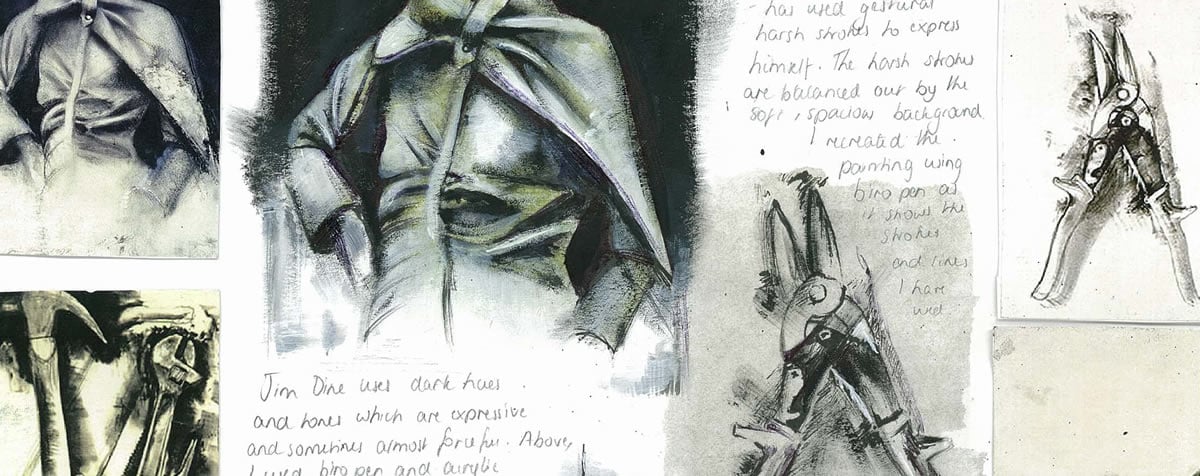
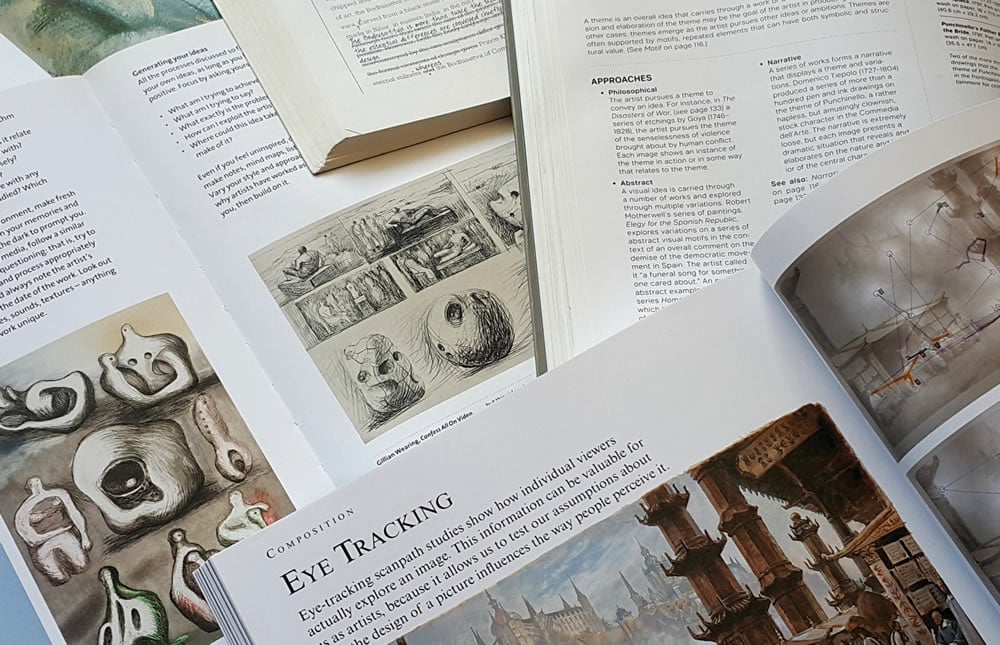
- Support writing with visual analysis. It is almost ever helpful for loftier schoolhouse students to support written material with sketches, drawings and diagrams that help the student understand and analyse the slice of art. This might include limerick sketches; diagrams showing the primary structure of an artwork; detailed enlargements of small sections; experiments imitating use of media or technique; or illustrations overlaid with arrows showing leading lines and then on. Visual investigation of this sort plays an important role in many artist studies.
Making sketches or drawings from works of fine art is the traditional, centuries-old way that artists have learned from each other. In doing this, you volition engage with a work and an artist's approach even if yous previously knew nothing well-nigh information technology. If possible practise this whenever you tin can, not from a postcard, the internet or a picture in a book, but from the actual work itself. This is useful because information technology forces you to look closely at the work and to consider elements you lot might not accept noticed before. – Susie Hodge, How to Look at Fine art7
Finally, when writing about art, students should communicate with clarity; demonstrate subject-specific knowledge; use correct terminology; generate personal responses; and reference all content and ideas sourced from others. This is explained in more particular in our article about high schoolhouse sketchbooks.
What should students write about?
Although each attribute of composition is treated separately in the questions beneath, students should consider the relationship betwixt visual elements (line, shape, form, value/tone, color/hue, texture/surface, space) and how these interact to form design principles (such as unity, variety, emphasis, potency, balance, symmetry, harmony, motion, contrast, rhythm, pattern, scale, proportion) to communicate meaning.
As complex as works of art typically are, there are really only three general categories of statements one tin make about them. A statement addresses form, content or context (or their diverse interrelations). – Dr. Robert J. Belton, Fine art History: A Preliminary Handbook, The University of British Columbia5
…a formal analysis – the result of looking closely – is an assay of the form that the creative person produces; that is, an analysis of the piece of work of fine art, which is fabricated upwardly of such things as line, shape, color, texture, mass, composition. These things give the rock or sail its form, its expression, its content, its meaning. – Sylvan Barnet, A Short Guide to Writing About Art2
This video by Dr. Beth Harris, Dr. Steven Zucker and Dr. Naraelle Hohensee provides an fantabulous example of how to analyse a piece of fine art (it is important to annotation that this video is an example of 'formal analysis' and doesn't include contextual analysis, which is also required past many loftier school art examination boards, in addition to the formal assay illustrated here):
Limerick analysis: a list of questions
The questions beneath are designed to facilitate direct date with an artwork and to encourage a breadth and depth of understanding of the artwork studied. They are intended to prompt college order thinking and to assistance students make it at well-reasoned analysis.
Information technology is non expected that students reply every question (doing and then would result in responses that are excessively long, repetitious or formulaic); rather, students should focus upon areas that are most helpful and relevant for the artwork studied (for example, some questions are appropriate for analyzing a painting, simply not a sculpture). The words provided as examples are intended to assist students think about advisable vocabulary to use when discussing a detail topic. Definitions of more complex words take been provided.
Students should not attempt to copy out questions so answer them; rather the questions should exist considered a starting signal for writing bullet pointed annotation or sentences in paragraph grade.
CONTENT, CONTEXT AND Pregnant
Subject area matter / themes / problems / narratives / stories / ideas
There can be different, competing, and contradictory interpretations of the same artwork.
An artwork is not necessarily near what the artist wanted it to exist about. – Terry Barrett, Criticizing Fine art: Understanding the Gimmicky6
Our involvement in the painting grows merely when we forget its championship and accept an interest in the things that it does not mention…" – Françoise Barbe-Gall, How to Look at a Painting8
- Does the artwork autumn within an established genre (i.e. historical; mythical; religious; portraiture; mural; still life; fantasy; architectural)?
- Are there whatever recognisable objects, places or scenes? How are these presented (i.due east. idealized; realistic; indistinct; hidden; distorted; exaggerated; stylized; reflected; reduced to simplified/minimalist class; archaic; abstracted; concealed; suggested; blurred or focused)?
- Accept people been included? What can we tell almost them (i.e. identity; age; attire; profession; cultural connections; health; family unit relationships; wealth; mood/expression)? What can nosotros learn from their pose (i.e. frontal; profile; partly turned; body language)? Where are they looking (i.east. direct eye contact with viewer; downcast; interested in other subjects within the artwork)? Can we work out relationships betwixt figures from the way they are posed?
What do the habiliment, effects, accessories (horses, swords, dogs, clocks, business ledgers and so forth), background, angle of the head or posture of the head and torso, direction of the gaze, and facial expression contribute to our sense of the figure's social identity (monarch, chaplain, bays wife) and personality (intense, cool, inviting)? – Sylvan Barnet, A Short Guide to Writing Nearly Arttwo
- What props and important details are included (mantle; costumes; beautification; architectural elements; emblems; logos; motifs)? How do aspects of setting support the primary bailiwick? What is the outcome of including these items inside the arrangement (visual unity; connections between different parts of the artwork; directs attention; surprise; diversity and visual interest; separates / divides / borders; transformation from one object to another; unexpected juxtaposition)?
If a waiter served you a whole fish and a scoop of chocolate water ice cream on the same plate, your surprise might be acquired past the juxtaposition, or the side-by-side dissimilarity, of the two foods. – Vocabulary.com
A motif is an chemical element in a composition or pattern that tin exist used repeatedly for decorative, structural, or iconographic purposes. A motif tin exist representational or abstruse, and it tin exist endowed with symbolic meaning. Motifs tin can be repeated in multiple artworks and often recur throughout the life'south work of an individual artist. – John A. Parks, Universal Principles of Artxi
- Does the artwork communicate an activity, narrative or story (i.due east. historical result or illustrate a scene from a story)? Has the arrangement been embellished, fix upward or contrived?
- Does the artwork explore movement? Exercise you gain a sense that parts of the artwork are about to change, topple or fall (i.due east. tension; suspense)? Does the artwork capture objects in motion (i.e. multiple or sequential images; blurred edges; scene frozen mid-action; live performance art; video art; kinetic fine art)?
- What kind of abstract elements are shown (i.due east. bars; shapes; splashes; lines)? Take these been derived from or inspired past realistic forms? Are they the result of spontaneous, accidental creation or careful, deliberate arrangement?
- Does the work include the cribbing of piece of work by other artists, such every bit within a parody or pop art? What effect does this take (i.e. copyright concerns)?
Parody: mimicking the appearance and/or way of something or someone, but with a twist for comic upshot or critical annotate, as in Saturday Night Alive'southward political satires – Dr. Robert J. Belton, Art History: A Preliminary Handbook, The University of British Columbia5
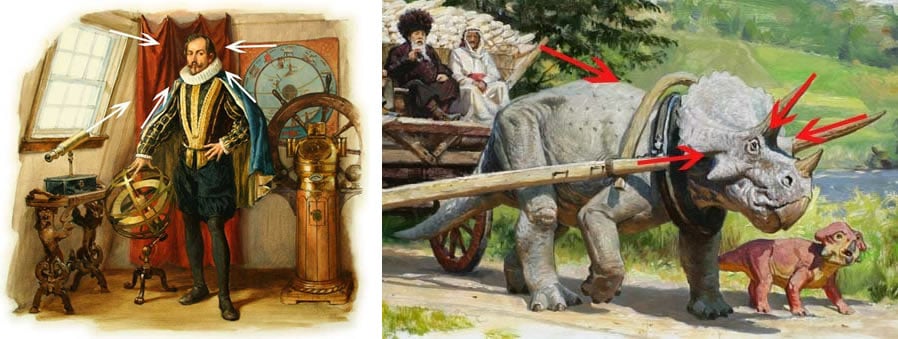
- Does the subject captivate an instinctual response, such as items that are informative, shocking or threatening for humans (i.e. dangerous places; abnormally positioned items; human faces; the gaze of people; movement; text)? Heap map tracking has demonstrated that these elements grab our attending, regardless of where they are positioned –James Gurney writes more nearly this fascinating topic.
- What kind of text has been used (i.e. font size; font weight; font family; stenciled; mitt-drawn; estimator-generated; printed)? What has influenced this pick of text?
- Do fundamental objects or images have symbolic value or provide a cue to meaning? How does the artwork convey deeper, conceptual themes (i.e. apologue; iconographic elements; signs; metaphor; irony)?
Allegory is a device whereby abstract ideas can be communicated using images of the concrete earth. Elements, whether figures or objects, in a painting or sculpture are endowed with symbolic meaning. Their relationships and interactions combine to create more complex meanings. – John A. Parks, Universal Principles of Art11
An iconography is a particular range or system of types of image used by an artist or artists to convey particular meanings. For example in Christian religious painting at that place is an iconography of images such as the lamb which represents Christ, or the dove which represents the Holy Spirit. – Tate.org.uk
- What tone of phonation does the artwork have (i.e. deliberate; honest; autobiographical; obvious; direct; unflinching; confronting; subtle; cryptic; uncertain; satirical; propagandistic)?
- What is your emotional response to the artwork? What is the overall mood (i.east positive; energetic; excitement; serious; sedate; peaceful; at-home; melancholic; tense; uneasy; uplifting; foreboding; calm; turbulent)? Which subject matter choices help to communicate this mood (i.e. atmospheric condition and lighting conditions; color of objects and scenes)?
- Does the title alter the style y'all interpret the piece of work?
- Were there any design constraints relating to the field of study matter or theme/s (i.eastward. a sculpture commissioned to represent a specific subject, place or idea)?
- Are there thematic connections with your ain project? What tin you learn from the style the creative person has approached this subject?
Wider contexts
All fine art is in part about the earth in which it emerged. – Terry Barrett, Criticizing Art: Agreement the Contemporary6
- Supported by research, can you identify when, where and why the work was created and its original intention or purpose (i.east. private sale; commissioned for a specific owner; commemorative; educational; promotional; illustrative; decorative; confrontational; useful or applied utility; communication; created in response to a design cursory; individual viewing; public viewing)? In what fashion has this background influenced the outcome (i.e. availability of tools, materials or time; expectations of the patron / audience)?
- Where is the place of construction or design site and how does this influence the artwork (i.eastward. reflects local traditions, craftsmanship, or customs; complements surrounding designs; designed to accommodate atmospheric condition conditions / climate; built on historic site)? Was the artwork originally located somewhere different?
- Which events and surrounding environments have influenced this work (i.e. natural events; social movements such as feminism; political events, economic situations, celebrated events, religious settings, cultural events)? What upshot did these have?
- Is the piece of work feature of an artistic manner, movement or time menses? Has it been influenced past trends, fashions or ideologies? How tin can you lot tell?
- Can you make any relevant connections or comparisons with other artworks? Have other artists explored a similar subject in a similar way? Did this occur before or later this artwork was created?
- Can you lot make any relevant connections to other fields of study or expression (i.e. geography, mathematics, literature, film, music, history or scientific discipline)?
- Which key biographical details about the artist are relevant in understanding this artwork (upbringing and personal state of affairs; family unit and relationships; psychological state; health and fitness; socioeconomic condition; employment; ethnicity; culture; gender; education, religion; interests, attitudes, values and beliefs)?
- Is this artwork part of a larger body of work? Is this typical of the work the artist is known for?
- How might your own upbringing, beliefs and biases distort your interpretation of the artwork? Does your own response differ from the public response, that of the original audience and/orinterpretation by critics?
- How do these wider contexts compare to the contexts surrounding your own piece of work?
COMPOSITION AND Course
Format
- What is the overall size, shape and orientation of the artwork (i.e. vertical, horizontal, portrait, mural or square)? Has this format been influenced past applied considerations (i.eastward. availability of materials; brandish constraints; pattern cursory restrictions; screen sizes; common aspect ratios in moving-picture show or photography such as four:3 or ii:iii; or paper sizes such every bit A4, A3, A2, A1)?
- How do images fit within the frame (cropped; truncated; shown in total)? Why is this format appropriate for the subject matter?
- Are different parts of the artwork physically separate, such every bit within a diptych or triptych?
- Where are the boundaries of the artwork (i.due east. is the artwork cocky-contained; compact; penetrating; sprawling)?
- Is the artwork site-specific or designed to exist displayed across multiple locations or environments?
- Does the artwork accept a stock-still, permanent format, or was itmodified, moved or adapted over fourth dimension? What causes such changes (i.e. weather and exposure to the elements – melting, erosion, discoloration, decomposable, wind movement, surface abrasion; structural failure – slap-up, breaking; damage acquired by unpredictable events, such as fire or vandalism; intentional motility, such equally rotation or sensor response; intentional impermanence, such as an installation assembled for an exhibition and removed afterwards; viewer interaction; additions, renovations and restoration by subsequent artists or users; a project then expansive information technology takes years to construct)? How does this alter bear upon the artwork? Are at that place stylistic variances between parts?
- How does the scale and format of the artwork chronicle to the environs where it is positioned, used, installed or hung (i.east. harmonious with landscape typography; sensitive to side by side structures; imposing or dwarfed by environment; human calibration)? Is the artwork designed to be viewed from one vantage point (i.e. front facing; viewed from beneath; approached from a main entrance; set at human being heart level) or many? Are images taken from the best angle?
- Would a similar format benefit your own project? Why / why not?
Structure / layout
- Has the artwork been organised using a formal organization of arrangement or mathematical proportion (i.e. rule of thirds; gilt ratio or spiral; grid format; geometric; dominant triangle; or round composition) or is the arrangement less predictable (i.e. chaotic, random, accidental, fragmented, meandering, scattered; irregular or spontaneous)? How does this system of arrangement help with the communication of ideas? Tin you draw a diagram to bear witness the bones structure of the artwork?
- Can you run into a clear intention with alignment and positioning of parts within the artwork (i.e. edges aligned; items spaced equally; simple or circuitous system; overlapping, clustered or concentrated objects; dispersed, separate items; repetition of forms; items extending across the frame; frames within frames; bordered perimeter or patterned edging; broken borders)? What effect do these visual devices accept (i.e. imply hierarchy; assist the viewer understand relationships between parts of artwork; create rhythm)?
- Does the artwork have a master axis of symmetry (vertical, diagonal, horizontal)? Can you locate a middle of balance? Is the artwork symmetrical, asymmetrical (i.e. stable), radial, or intentionally unbalanced (i.e. to create tension or unease)?
- Can you draw a diagram to illustrate emphasis and dominance (i.e. 'blocking in' mass, where the 'heavier' dominant forms announced in the composition)? Where are dominant items located within the frame?
- How practice your eyes movement through the composition?
- Could your own artwork apply a like organisational structure?
Line
- What types of linear mark-making are shown (thick; sparse; short; long; soft; bold; delicate; feathery; indistinct; faint; irregular; intermittent; freehand; ruled; mechanical; expressive; loose; blurred; dashing; cross-hatching; meandering; gestural, fluid; flowing; jagged; spiky; sharp)? What atmosphere, moods, emotions or ideas do these evoke?
- Are at that place whatever interrupted, suggested or implied lines (i.e. lines that can't literally be seen, but the viewer'due south encephalon connects the dots between separate elements)?
- Where are the dominating lines in the composition and what is the effect of these? Tin can you overlay tracing paper upon an artwork to illustrate some of the important lines?
- Repeating lines: may simulate material qualities, texture, design or rhythm;
- Boundary lines: may segment, divide or separate unlike areas;
- Leading lines: may manipulate the viewer's gaze, directing vision or pb the eye to focal points (heart tracking studies indicate that our eyes leap from one point of interest to another, rather than motion smoothly or predictably along leading lines9. Lines may nonetheless help to establish accent by 'pointing' towards certain items);
- Parallel lines: may create a sense of depth or motility through space within a landscape;
- Horizontal lines: may create a sense of stability and permanence;
- Vertical lines: may propose height, reaching upwards or falling;
- Intersecting perpendicular lines: may suggest rigidity, forcefulness;
- Abstract lines: may balance the composition, create dissimilarity or emphasis;
- Angular / diagonal lines: may advise tension or unease;
- Cluttered lines: may suggest a sense of agitation or panic;
- Underdrawing, construction lines or contour lines: describe form (learn more near contour lines in our commodity about line cartoon);
- Curving / organic lines: may suggest nature, peace, movement or energy.
- What is the relationship between line and three-dimensional form? Areoutlines used to define course and edges?
- Would information technology be appropriate to use line in a similar way within your own artwork?
Shape and form
- Can you identify a dominant visual language within the shapes and forms shown (i.eastward. geometric; angular; rectilinear; curvilinear; organic; natural; fragmented; distorted; costless-flowing; varied; irregular; complex; minimal)? Why is this visual language appropriate?
- How are the edges of forms treated (i.e. do they fade away or blur at the edges, every bit if melting into the page; ripped or torn; distinct and hard-edged; or, in the words of James Gurney9, do they 'dissolve into sketchy lines, paint strokes or drips')?
- Are there any 3-dimensional forms or relief elements within the artwork, such every bit carved pieces, protruding or sculptural elements? How does this affect the viewing of the piece of work from different angles?
- Is in that location a variety or repetition of shapes/forms? What event does this have (i.e. repetition may reinforce ideas, remainder composition and/or create harmony / visual unity; variety may create visual interest or overwhelm the viewer with chaos)?
- How are shapes organised in relation to each other, or with the frame of the artwork (i.due east. grouped; overlapping; repeated; echoed; fused edges; touching at tangents; contrasts in scale or size; distracting or awkward junctions)?
- Are silhouettes (external edges of objects) considered?
All shapes have silhouettes, and vision research has shown that one of the beginning tasks of perception is to be able to sort out the silhouette shapes of each of the elements in a scene. – James Gurney, Imaginative Realismix
- Are forms designed with ergonomics and human scale in mind?
Ergonomics: an engineering concerned with designing and arranging things people utilise so that the people and things collaborate most efficiently and safely – Merriam-webster.com
- Tin can you place which forms are functional or structural, versus ornamental or decorative?
- Have whatever forms been disassembled, 'cutting away' or exposed, such as a exclusive drawing? What is the purpose of this (i.eastward. to explicate construction methods; communicate information; dramatic event)?
- Would it be appropriate to use shape and form in a similar fashion within your own artwork?
Value / tone / light
- Has a broad tonal range been used in the artwork (i.e. a broad range of darks, highlights and mid-tones) or is the tonal range limited (i.due east. pale and faint; subdued; dull; brooding and dark overall; strong highlights and shadows, with lilliputian mid-tone values)? What is the effect of this?
- Where are the light sources within the artwork or scene? Is in that location a single consistent light source or multiple sources of light (sunshine; calorie-free bulbs; torches; lamps; luminous surfaces)? What is the effect of these choices (i.e. mimics natural lighting weather condition at a certain fourth dimension of day or night; figures lit from the side to clarify grade; contrasting background or spot-lighting used to accentuate a focal surface area; soft and diffused lighting used to mute contrasts and minimize harsh shadows; dappled lighting to signal sunshine broken by surrounding leaves; chiaroscuro used to exaggerate theatrical drama and impact; areas cloaked in darkness to minimize visual complexity; to enhance our understanding of narrative, mood or meaning)?
1 of the near important ways in which artists can use calorie-free to achieve particular effects is in making strong contrasts betwixt low-cal and dark. This contrast is oft described as chiaroscuro. – Matthew Treherne, Analysing Paintings, University of Leeds3
- Are representations of iii-dimensional objects and figures flat or tonally modeled? How do dissimilar tonal values modify from i to the next (i.e. gentle, smoothen gradations; sharp tonal bands)?
- Are there any unusual, reflective or transparent surfaces, mediums or materials which reflect or transmit light in a special mode?
- Has tone been used to help communicate atmospheric perspective (i.e. paler and bluer equally objects go farther away)?
- Are gallery or environmental light sources where the artwork is displayed stock-still or fluctuating? Does the work appear different when viewed at different times of day? How does this affect your interpretation of the work?
- Are shadows depicted within the artwork? What is the effect of these shadows (i.eastward. anchors objects to the page; creates the illusion of depth and space; creates dramatic contrasts)?
- Practice sculptural protrusions or relief elements grab the low-cal and/or create cast shadows or pockets of shadow upon the artwork? How does this influence the viewer's experience?
- How has tone been used to aid direct the viewer's attention to focal areas?
- Would it be appropriate to use value / tone in a similar way within your own artwork? Why / why not?
Color / hue
- Can you view the true color of the artwork (i.e. are yous viewing a low-quality reproduction or examining the artwork in poor lighting)?
- Whichcolor schemes take been used within the artwork (i.e. harmonious; complementary; primary; monochrome; earthy; warm; cool/cold)? Has the creative person used a broad or limited colour palette (i.e. variety or unity)? Which colors dominate?
- How would you describe the intensity of the colors (vibrant; bright; vivid; glowing; pure; saturated; strong; dull; muted; pale; subdued; bleached; diluted)?
- Are colors transparent or opaque? Can y'all come across reflected color?
- Has color contrast been used inside the artwork (i.e. extreme contrasts; juxtaposition of complementary colors; garish / clashing / jarring)? Are there any abrupt color changes or unexpected uses of color?
- What is the issue of these colour choices (i.e. expressing symbolic or thematic ideas; descriptive or realistic delineation of local color; emphasizing focal areas; creating the illusion of aerial perspective; relationships with colors in surrounding surround; creating balance; creating rhythm/blueprint/repetition; unity and variety within the artwork; lack of color places emphasis upon shape, item and form)? What kind of atmosphere practice these colors create?
It is frequently said that warm colors (ruby-red, orange, yellow) come forrard and produce a sense of excitement (yellow is said to propose warmth and happiness, as in the smiley face up), whereas cool colors (blue, green) recede and have a calming effect. Experiments, however, have proved inconclusive; the response to colour – despite clichés nearly seeing red or feeling blue – is highly personal, highly cultural, highly varied. – Sylvan Barnet, A Brusk Guide to Writing About Art2
- Would information technology be appropriate to apply color in a similar way within your ain artwork?
Texture / surface / pattern
- Are there any interesting textural, tactile or surface qualities within the artwork (i.e. bumpy; grooved; indented; scratched; stressed; crude; smooth; shiny; varnished; glassy; glossy; polished; matte; sandy; grainy; gritted; leathery; spiky; silky)? How are these created (i.e. inherent qualities of materials; impasto mediums; sculptural materials; illusions or implied texture, such as cross-hatching; finely detailed and intricate areas; organic patterns such as foliage or pocket-sized stones; repeating patterns; ornamentation)?
- How are textural or patterned elements positioned and what effect does this take (i.eastward. used intermittently to provide variety; repeating blueprint creates rhythm; patterns broken create focal points; textured areas create visual links and unity betwixt separate areas of the artwork; residuum betwixt detailed/textured areas and simpler areas; sleeky surface creates a sense of luxury; imitation of texture conveys information about a subject, i.e. softness of fur or strands of hair)?
- Would information technology be appropriate to use texture / surface in a similar mode within your own artwork?
Space
- Is the pictorial space shallow or deep? How does the artwork create the illusion of depth (i.east. layering of foreground, eye-basis, groundwork; overlapping of objects; employ of shadows to anchor objects; positioning of items in relationship to the horizon line; linear perspective – learn more about one point perspective here; tonal modeling; relationships with adjacent objects and those in shut proximity – including the man class – to create a sense of scale; spatial distortions or optical illusions; manipulating scale of objects to create 'surrealist' spaces where truthful scale is unknown)?
- Has an unusual viewpoint been used (i.east. worm's view; aerial view, looking out a window or through a doorway; a scene reflected in a mirror or shiny surface; looking through leaves; multiple viewpoints combined)? What is the event of this viewpoint (i.east. allows certain parts of the scene to be dominant and overpowering or squashed, condensed and foreshortened; or suggests a narrative between two separate spaces; provides more information well-nigh a space than would normally exist seen)?
- Is the accent upon mass or void? How densely arranged are components within the artwork or picture plane? What is the relationship between object and surrounding space (i.e. compact / crowded / busy / densely populated, with little surrounding space; spacious; careful interplay betwixt positive and negative infinite; objects clustered to create areas of visual involvement)? What is the effect of this (i.e. creates a sense of emptiness or isolation; business / visual clutter creates a feeling of anarchy or claustrophobia)?
- How does the artwork engage with real space – in and around the artwork (i.e. cocky-independent; closed off; eye contact with viewer; reaching outwards)? Is the viewer expected to move through the artwork? What is the relationship between interior and exterior infinite? What connections or contrasts occur betwixt within and out? Is it comprised of a series of separate or linked spaces?
- Would it exist appropriate to utilize space in a similar way within your own artwork?
Apply of media / materials
- What materials and mediums has the artwork been constructed from? Accept materials been concealed or presented deceptively (i.east. is in that location an authenticity / honesty of materials; are materials historic; is the structure visible or exposed)? Why were these mediums selected (weight; color; texture; size; strength; flexibility; pliability; fragility; ease of utilise; cost; cultural significance; durability; availability; accessibility)? Would other mediums have been advisable?
- Which skills, techniques, methods and processes were used (i.e. traditional; conventional; industrial; gimmicky; innovative)? It is important to note that the examiners do not want the regurgitation of long, technical processes, but rather to see personal observations nearly how processes effect and influence the artwork in question. Would replicating function of the artwork help you proceeds a ameliorate agreement of the processes used?
- Has the artwork been built in layers or stages? For example:
- Painting: gesso basis > textured mediums > underdrawing > blocking in colors > defining form > final details;
- Architecture: cursory > concepts > development > working drawings > foundations > structure > cladding > finishes;
- Graphic blueprint: brief > concepts > development > Photoshop > proofing > printing.
- How does the use of media help the creative person to communicate ideas?
- Are these methods useful for your own project?
Finally, remember that these questions are a guide only and are intended to make you start to call back critically almost the art you lot are studying and creating.

Further Reading
If you enjoyed this article you may too like our article virtually high schoolhouse sketchbooks (which includes a section about sketchbook annotation). If you lot are looking for more help with how to write an art analysis essay you may like our series well-nigh writing an artist study.
BIBLIOGRAPHY
- A guide for Analyzing Works of Art; Sculpture and Painting, Durantas
- A Brusk Guide to Writing About Art, Sylvan Barnet (Amazon affiliate link)
- Analysing Paintings, Matthew Treherne, Academy of Leeds
- Fine art and Art History Tips, The University of Vermont
- Art History: A Preliminary Handbook, Dr. Robert J. Belton, The Academy of British Columbia
- Criticizing Art: Understanding the Contemporary, Terry Barrett (Amazon affiliate link)
- How to Expect at Fine art, Susie Hodge (Amazon affiliate link)
- How to Wait at a Painting, Françoise Barbe-Gall
- Imaginative Realism, James Gurney (Amazon chapter link)
- The Writing Heart, Academy of North Carolina at Chapel Loma
- Universal Principles of Art: 100 Key Concepts for Understanding, Analyzing and Practicing Art, John A. Parks (Amazon chapter link)

Amiria has been an Art & Blueprint teacher and a Curriculum Co-ordinator for seven years, responsible for the course blueprint and assessment of student work in two high-achieving Auckland schools. She has a Bachelor of Architectural Studies, Bachelor of Compages (First Class Honours) and a Graduate Diploma of Teaching. Amiria is a CIE Accredited Art & Blueprint Coursework Assessor.
Source: https://www.studentartguide.com/articles/how-to-analyze-an-artwork
0 Response to "How Many Things Do You Have to Change in a Piece of Art to Use It"
Post a Comment